Ideas for Community Events: Bringing People Together with Gaming and Entertainment
Most community events fail before they start. Not because the idea is bad or the cause unworthy — but because the format feels like an obligation. People show up once, sit through something that could have been an email, and do not come back. Getting the format right matters just as much as getting the cause right. Experienced organizers approach this the same way seasoned players approach a new table at teddyslot casino — they read the room before committing. This guide covers what community events actually are, which types tend to work, some real community events examples worth borrowing from, and ideas for community events that use gaming and entertainment to make people genuinely want to be there.
What Are Community Events and Why They Matter for Local Communities
So what are community events, really? Strip away the formal definitions and you get something pretty simple: a community event is any organized gathering where the point is the people, not the product. It could be fifty neighbors around folding tables in a church basement. It could be a two-day outdoor festival on a town common. Scale is not what makes it a community event. Purpose is. The gathering exists to connect, serve, or celebrate the people who share a particular place.
Why that matters is not hard to see once you have been somewhere that lacks it. Towns where people do not know their neighbors are slower to respond to problems, quicker to assume the worst about each other, and much harder to organize around anything — a school budget fight, a zoning dispute, a local emergency. None of that is abstract. It plays out in real ways, in real places, all the time. Community events are one of the more reliable tools for preventing it.
In New Hampshire, this is not exactly a new conversation. The town meeting tradition here assumes that people already know each other well enough to argue productively in public. Community events — the informal ones, the seasonal ones, the low-stakes social ones — are part of how that familiarity gets built and maintained year to year. They are not separate from civic life. They are part of the infrastructure that makes civic life functional.
"You can pass all the policies you want, but if neighbors don't know each other, none of it sticks. Events are the glue."
— New Hampshire civic organizer, Merrimack County
Types of Community Events That Encourage Participation and Connection
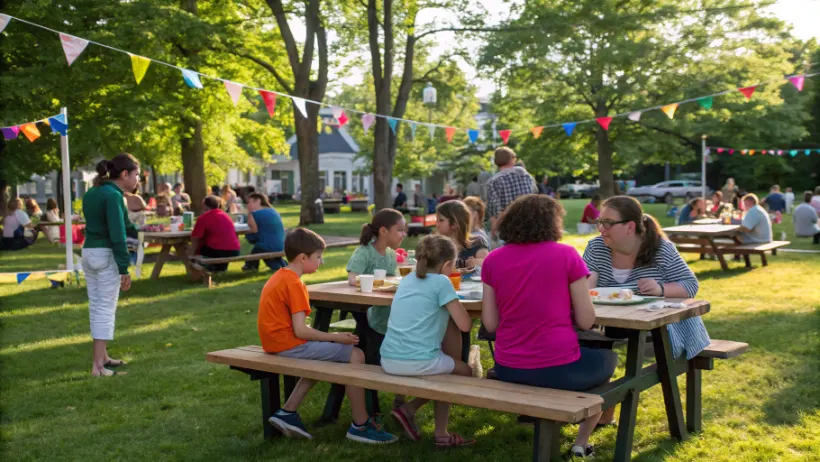
There is no single format that works for every community, every cause, or every time of year. The types of community events that consistently get people through the door tend to share one quality: they give attendees something to do rather than something to sit through. Passive formats — lectures, long presentations, formal dinners — have their place, but they rarely build the kind of loose, organic connection that makes a community feel like one.
Civic and educational gatherings cover town halls, public forums, issue briefings, and constitutional advocacy events. These attract people who are already paying attention, but they work better when there is a social component attached — coffee beforehand, drinks after, something that lets the conversation continue past the formal agenda. Cultural events like harvest fairs, heritage celebrations, and seasonal markets pull a wider crowd and are especially good at welcoming people who are newer to an area. Service days — cleanups, food drives, repair projects — attract a different personality type entirely but are surprisingly effective at creating lasting relationships, because people who work alongside each other remember it. And fundraising events, including gaming nights and auctions, are worth their own section.
| Event Type | Primary Goal | Best Audience | Typical Format |
|---|---|---|---|
| Civic and educational | Inform and advocate | Engaged residents and voters | Forum, panel, town hall |
| Cultural and celebratory | Build shared identity | Broad community, families | Festival, fair, seasonal market |
| Service and volunteer | Address a local need | Hands-on volunteers | Cleanup, drive, build day |
| Fundraising and gaming | Raise funds and connect donors | Supporters, business community | Casino night, auction, raffle |
| Youth and family | Support young people | Families, students, mentors | Sports league, fair, tutoring drive |
Community Events Examples: Festivals, Volunteer Projects, and Social Gatherings
It helps to look at community events examples that actually work rather than formats that sound good in a planning meeting. Across New Hampshire, the events with the longest track records are rarely the most elaborate ones. They are the ones that found a format people enjoy, kept it consistent year to year, and let word of mouth do the rest.
Fall harvest festivals are the obvious example. A good one does not need much — local vendors, something for kids, maybe a pie contest or a live band. What it needs is to happen at the same time every year, in the same place, so that it becomes part of the calendar rather than an event people have to decide whether to attend. The decision gets made by habit, which is exactly the point.
Volunteer project days work differently but just as well. There is something about working alongside someone — hauling brush, sorting donations, painting a fence — that skips past the small talk faster than any mixer format. People who met at a trail cleanup tend to remember each other. People who sat at the same table at a formal dinner often do not. If the goal is connection, give people something to do with their hands.
Smaller social gatherings — block parties, welcome events for new neighbors, informal meetups tied to a local issue — often get overlooked because they seem too simple to be worth organizing. They are not. Low-barrier events that require nothing from attendees except showing up tend to reach people that bigger, more structured events miss entirely.
- Seasonal harvest festivals with local vendors, music, and family activities
- River and trail cleanup days followed by a shared meal or social hour
- Neighborhood block parties organized by resident associations
- Welcome events for new residents hosted by civic or faith organizations
- Community garden workdays with seed swaps and informal workshops
- Holiday toy drives combined with family entertainment nights
- Public library reading events and author talks open to all ages
Gaming and Entertainment Activities at Modern Community Events
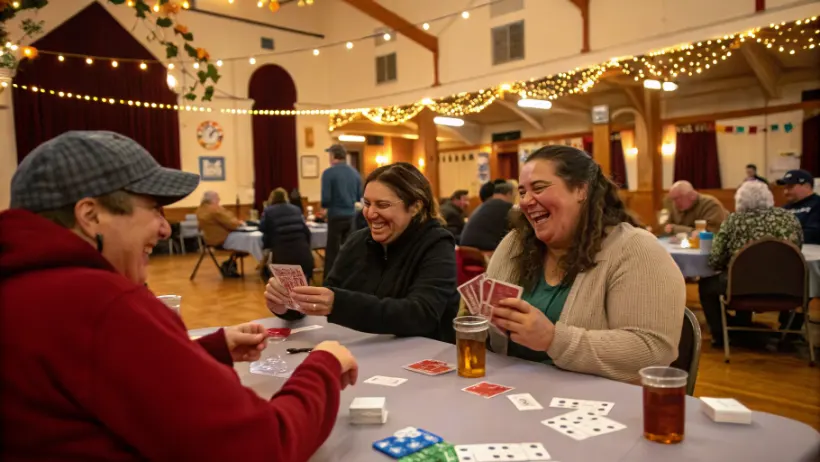
The shift toward gaming and entertainment at community fundraisers was not driven by novelty — it was driven by results. Charity casino nights started appearing on nonprofit calendars because they worked better than the formats they replaced. Ticket sales were stronger, people stayed longer, and the post-event donation numbers were higher. What gaming does that a dinner or an auction cannot is remove the social awkwardness of not knowing anyone. There is a table. There are cards. There is something happening. You do not need to be introduced — you are already playing.
What gaming does that a dinner or an auction cannot is remove the social awkwardness of not knowing anyone. There is a table. There are cards. There is something happening. You do not need to be introduced — you are already playing. That is not a small thing for people who are new to a community, new to an organization, or just introverted enough that a room full of strangers feels like work. Gaming gives them something to hide behind, briefly, until they do not need to anymore.
Trivia nights and bingo evenings work on the same principle at a lower cost and smaller scale. They are easy to run in a church hall or library room, they travel well across age groups, and they naturally generate the kind of competitive energy that keeps a room loud and engaged for two or three hours. Outdoor lawn games — bocce, cornhole, horseshoes — fill a similar role at summer festivals and neighborhood gatherings, creating informal activity zones where people drift in and out while conversations continue around them.
"When people are having fun, they let their guard down. That is when real conversations happen and real connections are made."
— Event coordinator, Southern New Hampshire nonprofit
Creative Ideas for Community Events That Bring People Together
The best ideas for community events usually come from asking a different question than "what should we organize?" The better question is: what do people here actually enjoy, and how do we build something around that? Generic events produce generic turnout. Events that feel made for a specific place, by people who actually live there, tend to generate the loyalty that keeps a community calendar alive year after year.
A few formats that have worked particularly well in New Hampshire communities and that adapt easily to different sizes and budgets:
- Skill-share fairs: Residents sign up to run a short workshop on something they know — bread baking, basic car maintenance, native plant identification, home repair basics. The event is both entertaining and genuinely useful, which is a combination that is harder to find than it sounds.
- Community storytelling nights: An open-mic format where people share personal stories about the town — how they ended up there, a neighbor they remember, something that changed. These build shared history across generations in a way that no formal history presentation ever quite manages.
- Neighborhood scavenger hunts: Mixed-age teams follow clues tied to local history, businesses, and landmarks. Cheap to run, high on engagement, and genuinely good for families who want to learn their surroundings.
- Charity casino and gaming nights: As covered above — broad appeal, strong fundraising potential, works for almost any group size.
- Outdoor film screenings: A projector, a white sheet, and a clear night are enough. People bring blankets and food. The barrier to attendance is almost zero, and the atmosphere tends to be warm in a way that is hard to manufacture with more expensive formats.
- Repair cafés: Volunteers with relevant skills help neighbors fix broken household items at no charge. The practical value brings people in; the atmosphere keeps them. Events like this tend to generate unusually genuine goodwill.
- Seasonal cook-offs: Chili, pie, barbecue — the format is old but it works. Competitive enough to create energy, low-stakes enough to stay fun, and the judging gives everyone in the room something to talk about.
- Civic trivia nights: Questions built around local history, current policy issues, or constitutional knowledge make civic education feel like a game rather than a duty. People who would never attend a public forum will show up for trivia night.
What ties the best ideas for community events together is not the format itself — it is the underlying logic. Make it easy to attend. Give people something to do. Create conditions where strangers can become acquaintances without it feeling forced. That is the whole design brief, and nearly any format can deliver on it if it is built around those three things.
New Hampshire has the civic culture to support strong community events. People here are used to showing up. The job of the organizer is mostly to give them somewhere worth going.